
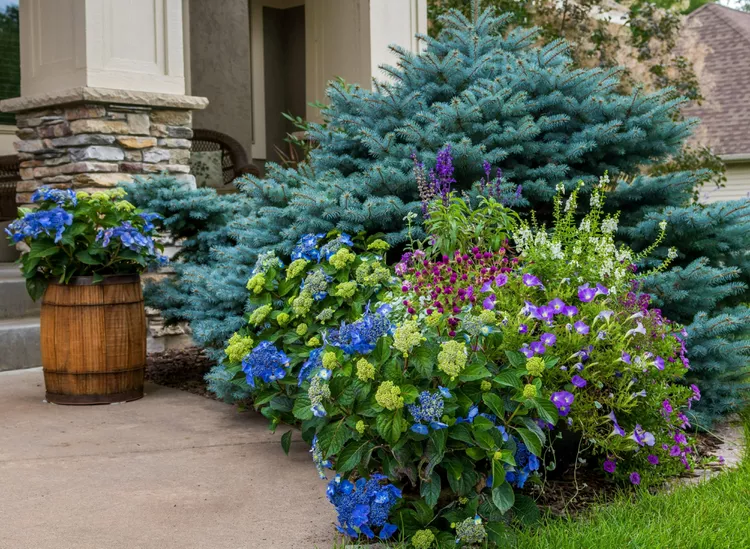
A compact, reblooming, very hardy, electric-blue hydrangea? Yes please! After nine years of trialing and testing, Endless Summer Pop Star from Bailey Nurseries is here to make a splash in your garden. Similar to other glamorous pop stars, this plant is already in high demand. It's been quickly selling out in nurseries across the country after it debuted this spring. Between its gorgeous flowers and easy maintenance, Pop Star is changing the game for hydrangea varieties for the better.
"Pop Star is setting that standard of bloom power, and the rebloom is something really, really special,” says Ryan McEnaney, Marketing and Communications Manager at Bailey Nurseries. And when it comes to hydrangea breeding efforts, "things keep getting better and better. I like to compare it to new cars," McEnaney says. "Even though my car from last year is great, the next one’s safety features, the engine, all of that just keeps getting better. And it's the same with hydrangeas and the breeding efforts that go into them."
The original Pop Star seedling came on the scene in 2014 at a Bailey breeding facility in Georgia. The goal was to create a short, stout, disease-resistant plant that would be a beautiful addition to garden borders and containers. That Pop Star seedling ended up crushing the competition through several years of trials.
A Better Hydrangea
Like other varieties in the Endless Summer collection, Pop Star is hardy in Zones 4-9 but even in the coldest areas, it will still reliably bloom the following year. During testing and trials, the Bailey Nurseries team found that even in temperatures below 0°F, Pop Star survived and bloomed the next year. “Even when Pop Star dies back, it has the power to not only produce new stems, but also produce flowers,” McEnaney says.
Pop Star hydrangeas stay compact, only growing 18 to 36 inches tall depending on the climate. The stems are very strong, which helps to keep the flower heads upright without additional support. And speaking of those flower heads, unlike what you might thing of as a typical hydrangea flower, Pop Star flowers are lacecaps rather than mopheads, meaning that they have a fine-textured, lacy look.
“We do have another lacecap hydrangea called Twist and Shout in the [Endless Summer] collection. But, Twist and Shout is a larger, big landscape and foundation plant or small hedge plant,” says McEnaney. He adds that Pop Star "is a different beast. It’s smaller and fits in different parts of the landscape. That’s something that’s been really fun to play with.”
Lacecap hydrangeas in general are great for attracting pollinators and Pop Star is no exception. This variety works well in mixed garden borders or in containers where its bright blue, lacy flowers can pop out of the landscape, says McEnaney. Depending on soil pH, this bigleaf hydrangea can also have pink flowers.
Long-Lasting Flowers for Arrangements
One reason people love to grow hydrangeas is to use the big blooms as cut flowers. Pop Star's bright coloring makes it an especially stunning flower to use in floral arrangements and it boasts a long vase life. "It's going to last longest as a cut flower if you wait until it's fully in color,” says McEnaney. And as long as you're cutting the flowers in summer, reblooming Pop Star will keep on producing more flowers to fill in.
McEnaney also points out that Pop Star's lacecap blooms work well for dried flowers. He recommends putting the stems in about 2 inches of water, letting it evaporate naturally. Over time, the bloom will dry by itself and you can use it as a long-lasting home decor piece.
How to Care for Pop Star Hydrangea
Watering
Hydrangeas grow best when their roots get consistent moisture, but still may wilt a bit on very warm afternoons. McEnaney says that Pop Star is less prone to wilting in comparison to other varieties and actually does not seem to need as much watering to survive and thrive.
Fertilizer
If your Pop Star hydrangea isn’t blooming, it may be because you're using the wrong kind of fertilizer. Bloom boosters with a higher phosphorus content will do best. If your Pop Star is planted in a garden bed next to a lawn, be careful not to let your nitrogen-heavy lawn fertilizer spread into the space. If your Pop Star is getting lots of nitrogen, it will promote green growth, but not flower production.
Pruning
Pop Star does not need much pruning, something quite unique about the variety, says McEnaney. “People don't have to worry about pruning for shape or size because it's just this perfect little splash of color in the landscape.” While pruning is not necessarily needed, deadheading the plant will promote new blooms from spring all the way through fall.
Container Care
When planted in containers, you'll need to protect this hydrangea in winter from the elements. If you’re in Hardiness Zone 4 to 6, McEnaney recommends moving the containers into a garage for the colder months. If you’re in warmer climates (Zones 7-9), all you have to do is provide protection from cold winds and Pop Star should come back year after year.