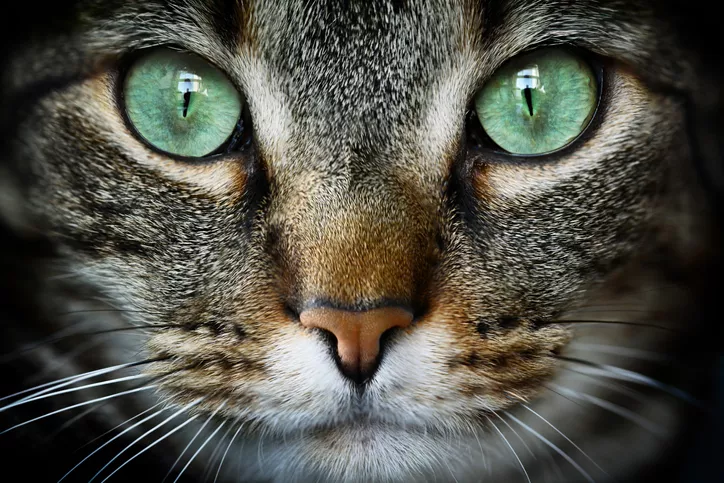
Veterinarians and scientists don't fully understand everything about cats, and how well they see is still one of those mysteries. Cats have been domestic pets for nearly 12,000 years, and we are still actively learning about them.
There are many myths about how well cats see, including that they can see in the dark and that their vision is better than ours. These oft-repeated ideas can make cats seem like supernatural beings.
In reality, cats can't see in total darkness, but they possess improved vision in darker settings thanks to their eyes' anatomy.
You may have heard they can, but this is only partially true. Cats don't have true “night vision” and, like us, cannot see in the complete absence of light.
However, cats are definitely able to see better in low-light environments than humans are. It can come in handy when they're stalking prey in the early morning or late evening hours. These times of the day are important for outdoor cats. They're hunting for food when many small prey animals are most active.
Many cat owners are confident their cat can, in fact, see in the dark. They get this impression because cats see well in low or little light. However, modern homes are rarely completely dark, and the light from street lamps, clocks, and other appliances allows just enough light for a cat to see.
Cats' vision involves their unique anatomy. Their eyes are large in proportion to their body size. Also, their vertical pupils can dilate to a much larger extent than a human pupil. These features allow in as much light as possible.
Moving down to the cellular level, the cat’s eye contains a much higher percentage of rods compared to a human eye. Rods are one of two types of light-sensitive cells in the retina at the back of the eye, and they turn the incoming light into electrical signals that are then transmitted to the brain. Rods primarily detect light and shadows, making them especially important in dim light. Cones, the other light-detecting cell, are primarily involved in color vision and spacial acuity.
Finally, cats have a reflective tapetum in the back of their eyes. This area, known as the tapetum lucidum, is responsible for the eerie greenish-yellow glow of cats’ eyes when caught in lights. This layer of the eye reflects light onto the retina and allows more light to hit more of the rods.
Pet parents are often curious how cats' vision compares to ours. Cats can see much better in low light than we can due because of their eyes' anatomy, but what about clarity and color?
In visual acuity, we excel over our cats. They don't see the world as clearly as we do. Typically, humans have more cones in their retinas than cats, allowing us to see sharper images and better spacial visualization.
We also boast better color vision than our cats. We believe, based on the types of cones in their eyes, cats don't see colors exactly the way humans do. Though we don't now everything about how cats perceive color, they likely see a more muted spectrum.

Ear Mites in Puppies and Dogs
Ear mites can be a big discomfort for puppies and dogs. Learn about the causes, treatment, and prevention to keep mites away from your pets.
5 Common Foods In Your Pantry That Are Not Safe For Your Pets
One potato chip is not going to hurt your pet, but there are other foods that can. Learn which to avoid and some safe foods that can be used as treats.
Metronidazole for Dogs
Metronidazole is a medication that is frequently given to dogs for bacterial infections and protozoan infestations of the colon. Here's what to expect if your dog is on this antibiotic.
Pulled Muscles in Dogs
A pulled muscle is one of the most common injuries seen in dogs. What can you do if your dog pulls a muscle and how can you prevent it?
Giardia in Dogs
Giardia is a parasite that can affect dogs, humans, and other animals. Learn about Giardia in dogs, including causes, diagnosis, and treatment.
Can Cats Have Raw Eggs?
Eggs are known to be a protein-packed breakfast staple in American homes. Can your cat eat raw eggs? Here's your answer.
What to Know Before You Buy Food and Water Bowls For Your Cat
Get some important information you need to know before buying food and water bowls for your cat or kitten.
Can Cats Eat Salami?
The inspiration for a popular series of memes, the answer to "can cats have salami?" is yes--but only in small amounts.
What Fruits Can Cats Eat?
Can cats eat fruit? Learn which fruits are safe for cats and which should be avoided. Here's how to safely offer fruit to your cat as a treat.
Can Dogs Eat Raw Chicken Feet?
What are the potential health benefits of chicken feet for dogs? What are the risks?
What to Know About Byproducts in Cat Food
Byproducts in cat food are safe and can provide excellent nutrition.
Do Cats Cry When They Are Sad or in Pain?
Cats don't cry the way people do. Your cat can produce tears, but not ones of sadness. Explore the truth behind a cat's emotions and what those tears mean.
Cat Bunting Behavior: What Does It Mean?
Cats rub their heads against prominent objects to leave scent markings as a part of scent communication.
Why Do Cats Wag Their Tails?
Understanding cat tail language can reveal the many reasons cats wag their tails, and there are many.
Can Cats See in the Dark?
Cats can see well in the dark but, like humans, they don't have complete night vision. They can see better than humans in low-light situations.
Cat Humping: Why a Neutered Cat Still Mounts
Even if your male cat is neutered, he may continue to mount and hump cats or other objects because of health problems or behavioral issues.
Thai Ridgeback: Dog Breed Characteristics & Care
Learn all about the Thai Ridgeback, a rare breed from Thailand. Find out how to care for the loyal dog and where to buy or adopt one.
Doberman Pinscher (Dobie): Dog Breed Characteristics & Care
Doberman pinschers are intelligent, loyal, and athletic dogs. Find out more about them, including their history, fearless nature, care, and needs.
14 Pointer Dog Breeds
Pointers extend past the English or German shorthaired pointer. Learn more about the history and temperament of 14 popular pointing breeds.
Bernedoodle: Dog Breed Characteristics & Care
The Bernedoodle is a hybrid dog breed created by crossing Bernese mountain dogs with poodles. Learn about their fun-loving personality and common health issues.