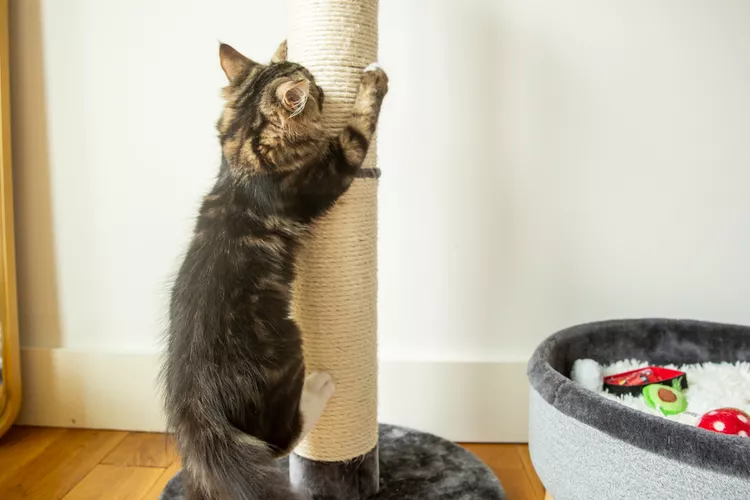
Cats don't scratch carpets out of spite or an instinct to destroy—scratching is a natural behavior for cats. Cats scratch things to care for their claws, mark surfaces, invite play, or attract attention, Most prefer to scratch surfaces that they can sink their claws into, like carpet, drapery, and upholstery—much to the dismay of cat owners.
It's important to stop your cat from scratching your carpet and other beloved possessions and direct the scratching to a better target so you can preserve your household furnishings (and your relationship with your cat).
Cats scratch by digging their front claws into a horizontal or vertical surface, then pulling their feet down or back. While this often damages the item being scratched, it provides a benefit to the cat. Scratching is an important part of a cat's health and well-being. There are a few reasons why cats scratch, and it all comes down to instinct.
The action of scratching, referred to as stropping, loosens and removes the outer layers of the claw to reveal a sharp new surface underneath. You may find these nail layers around your home, especially in areas where your cat likes to scratch. Claw sharpening is an act of grooming for the cat.
Scratching also exercises the muscles of the forelimbs and spine to keep the cat in top shape for hunting. Some cats will scratch by lying down and pulling their body weight along the floor. The surfaces they choose to scratch are usually fixed and nonyielding to provide resistance against the muscles they use to scratch.
Scratching is also used as a form of communication or marking behavior. The scent and sweat glands on the feet mix together and produce a unique smell. When claws are scraped down a surface, they leave behind marks, scents, and claw husks. Other cats can see and smell this like a message.
Outdoor cats may leave evidence of scratching on trees, fence posts, sheds, and wooden gates. It's no coincidence that these are all areas that are highly visible to other outdoor cats. Such scratching is a territorial behavior used to communicate with other cats and mark boundaries.
Indoor cats tend to find similar surfaces indoors to serve their instinct to scratch, often targeting softwoods, carpets, and fabric-covered furnishings.
In some cases, scratching is a precursor to play, either with another cat in the home or with human companions. It may also be a bid for attention. If a cat is routinely shooed or chased away when it scratches furniture or carpeting, it may come to associate scratching with receiving attention.
Your first option for preventing damage from scratching is to direct your cat's behavior to an acceptable target. Kitty furniture such as scratching posts are designed for that exact purpose.
What do you do if your cat refuses to use the scratching post or sometimes chooses to ignore it in favor of your carpeting? The best solution is to provide scratching surfaces that are more desirable to your cat than your furnishings.
Add a horizontal scratching pad. Cats have their own individual scratching patterns and preferences. Those who scratch carpeting may be more inclined to scratch horizontally than use a vertical scratching post. Fortunately, there are scratching pads made for horizontal scratching; some are wedge-shaped inclines and others are flattened out. Experiment to find one that your cat likes.
Add multiple scratching posts and pads, covered with different materials and different textures. The choice of different scratching options may relieve your cat of its need to sharpen its claws on your carpet. Many scratching posts are covered with carpet, but you should add one or two with a different material, such as sisal, corrugated cardboard, or even plain wood. Remember that cats like varying surface angles for scratching, ranging between horizontal and vertical. So ideally, provide at least one of each: a tall vertical scratching post, a flat scratching mat, and an inclined scratcher. Make sure scratching posts are heavy and sturdy so they remain fixed in place while your cat scratches them.
Cover up the spot where your cat scratches. If possible, move a piece of furniture (or a scratching post) to your cat's favorite carpet spot. A sisal scratching post may be a good choice here. For scratching that takes place in front of an entryway, cover the area with a thin mat. Two-sided tape can act as a deterrent and eventually train your cat to avoid the area, especially on vertical surfaces.
Infuse the area with scent. Use a feline pheromone plug-in or a spray like Feliway in the area where your cat has been scratching. Although these types of products aren't marketed specifically for this purpose, cat behaviorists have found that the "friendly pheromones" in these products can fool cats into believing the area has already been "marked" by another cat, often discouraging scratching behavior.
Consider your cat's anxiety level. A cat may resort to more frequent scratching if it's emotionally stressed, such as when it feels threatened by environmental changes or a new pet (or a new child) has recently become a part of the household. Paying more attention to your cat, including playing with it more often, may offer the reassurance it needs to give up its carpet-scratching habits.
While you're working on methods to stop your cat's carpet scratching, you'll want to minimize the damage to your home in the meantime. Trim your cat's claws regularly, using a sharp claw-trimming tool. This will help keep the damage to a minimum.
You may also wish to try a product like nail caps. These should only be applied to cats that allow you to handle and manipulate their paws. If you've never used nail caps before, many veterinarians and most large pet supply stores offer installation and training for a small fee. Your cat probably won't mind them, and they'll prevent the shredding-type of damage your cat sometimes inflicts on your rugs.
Edited by Jenna Stregowski, RVT

Ear Mites in Puppies and Dogs
Ear mites can be a big discomfort for puppies and dogs. Learn about the causes, treatment, and prevention to keep mites away from your pets.
5 Common Foods In Your Pantry That Are Not Safe For Your Pets
One potato chip is not going to hurt your pet, but there are other foods that can. Learn which to avoid and some safe foods that can be used as treats.
Metronidazole for Dogs
Metronidazole is a medication that is frequently given to dogs for bacterial infections and protozoan infestations of the colon. Here's what to expect if your dog is on this antibiotic.
Pulled Muscles in Dogs
A pulled muscle is one of the most common injuries seen in dogs. What can you do if your dog pulls a muscle and how can you prevent it?
Giardia in Dogs
Giardia is a parasite that can affect dogs, humans, and other animals. Learn about Giardia in dogs, including causes, diagnosis, and treatment.
Can Cats Have Raw Eggs?
Eggs are known to be a protein-packed breakfast staple in American homes. Can your cat eat raw eggs? Here's your answer.
What to Know Before You Buy Food and Water Bowls For Your Cat
Get some important information you need to know before buying food and water bowls for your cat or kitten.
Can Cats Eat Salami?
The inspiration for a popular series of memes, the answer to "can cats have salami?" is yes--but only in small amounts.
What Fruits Can Cats Eat?
Can cats eat fruit? Learn which fruits are safe for cats and which should be avoided. Here's how to safely offer fruit to your cat as a treat.
Can Dogs Eat Raw Chicken Feet?
What are the potential health benefits of chicken feet for dogs? What are the risks?
What to Know About Byproducts in Cat Food
Byproducts in cat food are safe and can provide excellent nutrition.
Do Cats Cry When They Are Sad or in Pain?
Cats don't cry the way people do. Your cat can produce tears, but not ones of sadness. Explore the truth behind a cat's emotions and what those tears mean.
Cat Bunting Behavior: What Does It Mean?
Cats rub their heads against prominent objects to leave scent markings as a part of scent communication.
Why Do Cats Wag Their Tails?
Understanding cat tail language can reveal the many reasons cats wag their tails, and there are many.
Can Cats See in the Dark?
Cats can see well in the dark but, like humans, they don't have complete night vision. They can see better than humans in low-light situations.
Cat Humping: Why a Neutered Cat Still Mounts
Even if your male cat is neutered, he may continue to mount and hump cats or other objects because of health problems or behavioral issues.
Thai Ridgeback: Dog Breed Characteristics & Care
Learn all about the Thai Ridgeback, a rare breed from Thailand. Find out how to care for the loyal dog and where to buy or adopt one.
Doberman Pinscher (Dobie): Dog Breed Characteristics & Care
Doberman pinschers are intelligent, loyal, and athletic dogs. Find out more about them, including their history, fearless nature, care, and needs.
14 Pointer Dog Breeds
Pointers extend past the English or German shorthaired pointer. Learn more about the history and temperament of 14 popular pointing breeds.
Bernedoodle: Dog Breed Characteristics & Care
The Bernedoodle is a hybrid dog breed created by crossing Bernese mountain dogs with poodles. Learn about their fun-loving personality and common health issues.